Saturday, September 13, 2014

Bologna! No Venice!

Day 1: Mantova
Individual arrival. The cabins are available from 4.30 p.m. The boat is moored at Porto Catena, just a short walk from the city centre. The meeting with the tour leader and the crew is scheduled at dinner-time, at 7 p.m. Mantova is one of the most beautiful towns in Northern Italy, where a lot of worldwide known artists left their master-pieces, thanks to the financial support of the famous Gonzaga family.
~~~~~~~~~~~~~

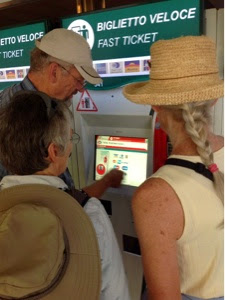
We are sitting on the train in the Rome Station. Robin and Bjarne are in the next car. It is 10:45 am and we get off at Bologna after 1pm and find the train to Mantova where we meet our barge and Group.


~~~~~~~~~~~~~~~~~~~~
It is now 3:15 and we've changed trains in Bologna and Medena. We are headed to Mantova.The first train we caught went to Venice by way of Bologna. We jumped off at Bologna (this time we did not want Venice) and got the train to Medena. Yes, Italy has nice trains but walking into a gigantic train station and finding the right track and train is no small feat. Bjarne is leading and Carol is second guessing and Robin and I follow blindly. Actually, Robin is savvy and knows what is going on. I am happy to be oblivious.


Stop at Carpi.

A few times we drag our heavy suitcases down the stairs at a station, under the tracks, then up the stairs on the other side of the tracks.

At Mantua Bjarne reads the map provided by Rad and Riessen and leads us from the train station to the port, about 2 miles of dragging suitcases. Nice city with fewer people. It was great to see our barge, the Ave Maria.


Introducing Mantua

As serene as the three lakes it sits beside, Mantua (Mantova) is home to sumptuous ducal palaces and a string of atmospheric, cobbled squares. Settled by the Etruscans in the 10th century, it has long been prosperous, the Latin poet Virgil was born just outside the modern town in 70 BC, Shakespeare's Romeo heard of Juliet's death here and Verdi set his tragic, 19th-century opera, Rigoletto, in its melancholy fog-bound streets.
Mantua's 400-year heyday, however, began in the 14th century when the city passed to the fast-living, art-loving Gonzaga dynasty, one of Italy's great Renaissance families. It rapidly became an important buffer state between the expansionist ambitions of Milan and Venice, and attracted leading lights such as writer Petrarch, Renaissance teacher Feltre and artists Mantegna, Rubens and Romano. Even now, and despite a worrying wobble after the earthquake of 2012, the city preserves its illustrious and antique history in its fabulous art and architecture. The golden days of 'La Gloriosa' ceased when Austria took control in 1708 and ruled (aside from the Napoleonic interlude in the late 1700s) until 1866, when Mantua joined Italy.


Read more: http://www.lonelyplanet.com/italy/lombardy-and-the-lakes/mantua#ixzz3DEUcnuvj

Friday, September 12, 2014

Pantheon and Navona Square


I request to sleep in until 8 this morning. No one argues. I have blisters on my toes and sunburn on my head. Breakfast at 9.


We walk first to the train station to buy tickets to Mantova on Saturday. That is where we meet the barge and other bikers. We must change trains in BOLOGNA. Then we buy bus tickets and use GoogleMaps to help us find the bus amidst hundreds lined up at the station. Takes us right to the bus!

ON THE bus we use GoogleMaps to tell us where and when to get off. We then use GoogleMaps to lead us to the Pantheon. Bjarne has THE LONELY PLANET guide and helps us to appreciate things on the way.


http://www.italyguides.it/us/roma/pantheon.htm

The Pantheon in Rome is the Roman monument with the greatest number of records: the best preserved, with the biggest brick dome in the history of architecture and is considered the forerunner of all modern places of worship. It is the most copied and imitated of all ancient works.

Michelangelo felt it was the work of angels, not men.

Where it stands was not chosen by chance, but is a legendary place in the city's history. According to Roman legend, it is the place where the founder of Rome, Romulus, at his death was seized by an eagle and taken off into the skies with the Gods.

But what was it for and what does the name mean?

The name comes from two Greek words pan, "everything" and teon "divine". Originally, the Pantheon was a small temple dedicated to all Roman gods. Built between 27 and 25 B.C. by the consul Agrippa, Prefect of the Emperor Augustus, the present building is the result of subsequent, heavy restructuring.

Domitian, in 80 A.D., rebuilt it after a fire; thirty years later it was hit by lightening and caught fire again. It was then rebuilt in its present shape by theEmperor Hadrian; under his reign, Rome reached its maximum splendour, and the present structure is probably the fruit of his eclectic genius and exotic tastes.

In fact, the Pantheon combines a clearly Roman, cylindrical structure with the splendid outer colonnade of Greek inspiration. Although the new structure was very different to the original, Hadrian wanted a Latin inscription on the façade, that translated means "It was built by Marcus Agrippa, son of Lucius, consul for the third time".


Thursday, September 11, 2014

I've Lost Carol Again . . .


I am sitting at the exit of the HUGE Vatican Museum. I have the Audio-guide radio around my neck. 
Somehow I am separated from Carol and Robin and Bjarne in the great river of humanity flowing 
through the museum. I head for the exit thinking we will find EACH OTHER. But an hour has passed. The good news is that Robin gave her Drivers License to get the radios for the four of us. She gets her license back when all four are returned. She has to use this exit. Thank goodness for the Audio-guide rule. Thank goodness there is a bench here. And thank goodness I still have water in my hydration "bladder". After 3 1/2 hours flowing through the rooms with the masses, a husband just called the experience the "Torture Tour".

~~~~~~~~~~~~

Breakfast together again at 8am. Thunder showers last night and the tables in the court yard are wet.  We walk to the subway station and buy our  tickets to ride to Vatican City and meet City Wonders Tour at 10:30 at the bottom of the stairs across from the museum. It is raining. Hundreds are lining the streets for entrance tickets. At least we should have ours soon and we have an email message to confirm it.

Our huge City Wonders Tour gathers and lines up inside the museum for a security check. We have a white dot on our shirts that allows us to enter without purchasing a ticket That gets us in the first gate. They tell us to get our Audio-guide on the second floor after we go in. Suddenly I panic. I thought we booked a group tour with an Englsh speaking guide! No, but for twice the money we can have the group tour . . . But we have to jump out of the line ASAP and come back tomorrow morning. We decide to stay with whatever it was we paid 44 Euros a piece for. We go through a Security Check just like at the airport. On the second floor we see another ticket gate. City Wonders did not give us a ticket for this gate.  Bjarne shows them his white dot and they are not impressed. We look for the City Wonders person but she is no where. We can't find any white dots either. How did we all miss this?  Bjarne is ready to purchase admission tickets as I try to find a phone number for City Wonders Tours and  ask them if we already paid for admission. The phone number does not work on Bjarne's phone. I volunteer to run downstairs an look for white dots. Downstairs three City Wonders employees spot my white dot and grab me. "We've be looking for you and were about to give up." They hand me 4 tickets that we paid for already. I run upstairs and am treated like a hero. We proceed to the line to pay for rhe Audio-guide. That is when Robin trades her license for 4 radios. They hand us a piece of paper that I assume is a map of the galleries and the number that we must push to hear the narration. It is about 11:30. We make a plan to meet in the garden by the gold globe at 1pm in case we get separated.

I walk into the first Gallery. There are many busts.  I push 1 on the Audio-guide. The narration does not match anything I see. I push 2.  No match. I look at the description of the Gallery and the icons on the map and am confused. The second Gallery has a name that matches an icon on the map that gives me a number to push on the Audio-guide. Helpful narration. I find narration for about  half of the next twenty Galleries. This is frustrating. Sometimes I show my map to the guard and he points to the map icon that has a number. I run into brilliant Carol and she shows me that half the Galleries are not on the map. You have to search each Gallery for a tiny red number. This Galleryis 53. It is NOT on the map.

~~~~~~~~~~~~~~

Yeah, I see Bjarne walking towards the exit. They have been looking for me and are glad to see me. They had a bite to eat. We return our Audio-tours and head around the Vatican for the Basilica. Whew!

~~~~~~~~~~~~~~~


Huge line at St Peter's Basilica. So hot but the line does move. I take out my umbrella to shield us from the sun.

Bjarne wants to show Robin the Spanish Steps. We buy Gelato on the way. We get on the subway and get off near the Spanish Steps and climb 135 more steps before walking uphill to look for the restaurant that was recommended to them. The restaurant is closed and will reopen later. Bjarne thinks we should not plan on that so head for the little restaurant with the real food sitting out front ever night. 
We have Pizza and Carol has a tuna pasta salad.


~~~~~~~~~~~~~~~~


Ancient Rome

At 8 am we meet Robin and Bjarne for breakfast in the courtyard of Domus Romana Inn and Residence.

Walk to find tickets for general overview bus tour like City Sightseeing in Florence.
A Bangladeshi salesman grabs us --- "I sell all tours. I give you just what you want. Any tour. Best price. Give me money now for ticket." Bjarne follows the young man to his travel office and we try to figure out what to do.  We get a one day tour bus pass and they charge extra 2%.

Another Bangladeshi salesman grabs me "This is your lucky day. Hat for $5, not regular price of $10."
I lost my sunglasses yesterday so need a hat for the sun. He wins.

Sit on top of bus and hold hat because it flies off in the breeze.  Traffic is horrendous in Rome, worse than Florence, so we sit a lot. I don't think we will ride it 3 X like we did in Florence. Bjarne calls the ride  "interminable".

On second time around we get off at the Roman Colosseum.

Bangladeshi salesman grabs us to say, "Skip the lines. Get a guided tour with expert English speaking guide."

We sign up and join a huge group of over 30. Guide is Italian but grew up in South Africa and  I can understand him when I can hear him. He has a little portable mic that doesn't seem to work. He 
guides  us through and is great. Then we are on our own until 2:30 when we meet our second guide at a different location for Palatine Hill and the Roman Forum. Two women from Libya ask to stay with us so they don't get lost. Fun to talk with them.


We are at the designated spot at 2:30 but no Guide. It is HOT and we lean against the only wall with shade. At 2:45 someone spots Arnoldo, our first guide. We all follow him but he says he is not working. He calls the office and is quite angry that our guide is not here. He shouts in Italian. She finally arrives.

She is Italian and speaks English but I cannot understand her very well. We go to Palatine Hill, one of the 7 hills of Rome. . . . She wants to sell us a ticket with her as guide at the Vatican tomorrow but I fear I won't be able to hear her. Bjarne gives her our names for a reservation.

Then we are on our own. Walk on Roman Road, Roman Forum, etc

Listen to an excellent American guide explain the arch commemorating the fall of Jerusalem. Ask a person in the group what tour they are with. CITY WONDERS TOUR.
I go online and we book tickets for a guided tour of the Vatican tomorrow with CITY WONDERS TOURS.

I use my iPad and GoogleMaps to get us back to the hotel. We bring our laundry to dinner and stick it in the wash on the way to dinner and pick it up on the way home.

Dinner again at

Gioia Mia Pisciapiano

Via degli Avignonesi 34
00187 Rome

order prosciutto and cantaloupe again, and mushrooms and peas. Yum.

So so tired but want to read more about what we saw today.

Pitti Palace and Train to Rome.

Pack up, check out, and put our luggage outside the room to retrieve at 2:30 pm.

Breakfast and then catch the CitySightseeing Tour Bus to Pitti Palace and Boboli Gardens.

Enter by the Formal Gardens and eventually find the Palace.

View the Costume Museum, the Silver Museum and then walk up the hill
to the highest point of the garden and eat a granola bar. . .

The Palazzo Pitti and Boboli Gardens

Piazza Pitti 1

This enormous palace is one of Florence's largest architectural monuments. The original palazzo was built for the Pitti family in 1457, designed by Filippo Brunelleschi and built by his pupil Luca Fancelli. The original construction consisted of only the middle cube of the present building (the middle seven windows on the top floor). In 1549, the property was sold to the Medicis and became the primary residence of the grand ducal family. The palace was then enlarged and altered; from 1560, Bartolomeo Ammannati designed and added the grandiose courtyard and two lateral wings. Under Cosimo II de' Medici, the layout of the piazza and opening up of the view were begun. The facade then assumed its present appearance, except for the two projecting wings, added by the House of Lorraine in the early 18th century. Behind the palace lie the famous Boboli Gardens.

Today, the Pitti Palace houses some of the most important museums in Florence: on the first floor is the Palatine Gallery, containing a broad collection 16th and 17th century paintings, and the Royal Apartments, containing furnishings from a remodeling done in the 19th century; on the ground floor and mezzanine the Silver Museum (Museo degli Argenti) displaying a vast collection of Medici household treasures; and the Gallery of Modern Art is on the top floor, holding a collection of mostly Tuscan 19th and 20th century paintings. In the separate Palazzina del Cavaliere on the upper slopes of the Boboli Gardens is the Porcelain Museum, while the Palazzina of the Meridiana contains the Costume Gallery, a showcase of the fashions of the past 300 years.


At that point I become totally disoriented in finding our
way to the place we entered the garden. Hurry to catch the tour bus back
to get our bags at the B & B. Drag our bags to the city bus
which takes us to the train station. Just enough time to get a small shake at
McDonald's which allows us to pay to use the bathroom
and sit down until our train comes.

Pleasant but cramped train ride to Rome. Lovely countryside.


Get into Rome about 5:00 and must navigate our way to our hotel.
Carol has the route mapped out but there is confusion when we come out of the
station and we can't figure out what road we are on and which direction
to face.

GoogleMaps saves the day and we drag our suitcases through a
very crowded city to our hotel Domus Romana following the little arrow on the screen. 
We walk through the doorway on a crowded street and find a lush courtyard and a nice room
with air-conditioner turned on and drinks in the frig! Robin found the Domus Romana Hotel and Residence on Booking.com in December. It was a convent, built in 1600.


Via delle Quattro Fontane, 113, Roma


Bjarne and Robin look thin and tan and happy to see us.

We eat at a great small Italian Restaurant and hear about their hike through the Dolomites.

Gioia Mia Pisciapiano

Via degli Avignonesi 34
00187 Rome
Italy

And How Many Steps?

Breakfast at the Le  Contesse B & B - yogurt, orange juice, pastry, and coffee .
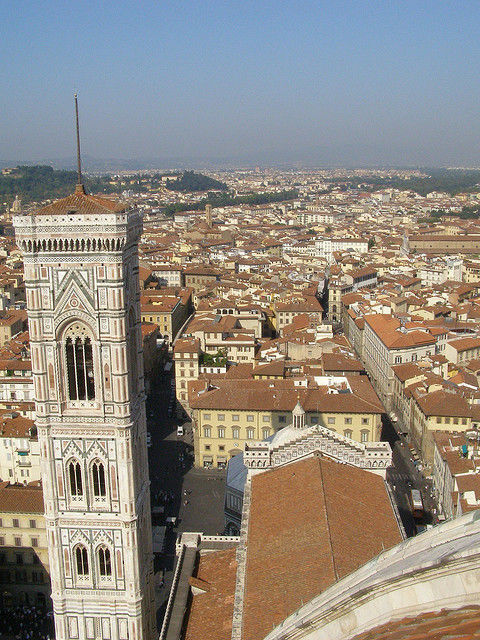
Carol forgets walking stick and returns to the room while I wait in circle which is bustling with activity and vehicles. Pass the Tower to check out lines to visit Il Duomo. Get in line and then find out we have to buy tickets at the Tower. Get in line at the Tower, buy tickets, and then get back in line for the Dome. Climb the 463 stone steps. Incredible view from the cupola. We look down on Giotto's tower.

Walk to train station to buy train tickets to Rome.
Eat lunch at McDonalds across from the Train Station  - NYC CHICKEN SANDWICH -
Walk back to Il Duomo and stand in line to go into the Santa Maria del Fiore Cathedral. Visit lowerst level and see remnants of orig buildings.

At this point I am too tired to do much else. Decide to buy ticket for city sightseeing  bus and it is the best idea! We take blue bus two times, then yellow and then red. Get to see all parts of the city with narration (ear buds). Plus it is cool on the top of the bus and we do not have to climb stairs, except to the top of the bus.

Slice of eggplant pizza for dinner.
Carol checks and rechecks bus stops for tomorrow's trip with luggage to the train station,
Back to B & B and pack for Rome.

How Many Steps?


Later Sunday afternoon we walk to 'Il Duomo' the dome of  the Cathedral of Santa Maria Fiore (the Florence Cathedral) and search for a place to buy tickets. Carol's research says you buy tickets in the museum. We fnally find the museum and there is a sign that says "Museum Closed until Nov 2014".  There are no signs anywhere about tickets but there are lines everywhere. We walk around the Cathedral a few times before we try a line into Giotto's Bell Tower. We buy tickets and climb the narrow staircase around and around to the top of the tower (477 ft. and 416 steps). That is about half of the Washingto Monument. Fabulous view of the city and Arno River. I notice the far hills in both directions with very large homes. 

Lasagna and gelato for dinner at inviting street Caffe Ricasoli.

I am exhausted. 

From an internet site:
Giotto Bell Tower


This beautiful and slender tower is unusually placed with respect to the cathedral; it is actually aligned with the church’s facade.
With construction of the church already underway, Arnolfo di Cambio decided to give to the tower an importance equal to the rest of the complex, while leaving sufficient space for the majestic dome that would come ​​later.
The bell-tower with the dome
In 1334, Giotto di Bondone (Vicchio 1267 – Florence 1337), an Italian painter and architect, was made chief architect for the building of the complex of Santa Maria del Fiore. He was a very popular, well-known artist during his time.
Vasari tells how Giotto was able to draw a perfect circle without a compass, the famous “O by Giotto”.
One of the most famous works of this artist are the frescos in the Basilica of Assisi, which depict the Stories of St. Francis. This masterpiece astonished Giotto’s contemporaries for its modernity and beauty.
However, according to legend, Giotto devoted himself particularly to the construction of the majestic bell tower in Florence, overlooking the building of the cathedral.
At the time of Giotto’s death in 1337, only the first blocks at the bottom had been laid​​, already displaying some of the tower’s structural weaknesses.
The anonymous fourteenth century author of a Commentary on the Divine Comedy recounts the legend that Giotto died of grief for having given the bell tower “a too small bed for your feet.” In reality, the base of the tower is more narrow than it should be, perhaps to give the effect of greater verticalmomentum.
Numerous structural problems emerged during its construction, and the Black Death that plagued Florence slowed down work until its eventual completion in 1359.
This bell tower is now considered the most beautiful tower in Italy, due to its architectural structure and decorations.
The external panelling consists of three different types of marble: white from Carrara, green from Monteferrato and pink from Maremma.
Marble decorations
While the authors of the numerous sculptures that decorate the bell tower have not yet been confirmed, it is thought that Giotto was the original designer.
Beautiful bas-reliefs are included in the famous “formelle” (panels), which symbolize the life of man from Creation onward, the planets, the virtues, the arts and the sacraments.
Formella with the Creation of Adam
One can climb the tower via a long spiraling staircase made from 463 steps. The view from the top is breathtaking; from this elevation, one can admire the entire center of the city up to Piazzale Michelangelo and the surrounding hills.
The campanile from the dome